USDA's New REAP Rule: Build First, Apply Later. What It Means for Rural Operators
On October 1, USDA published a final rule that rewrites how the Rural Energy for America Program (REAP) awards grants, and it took effect October 16. For agricultural producers and rural small businesses that have relied on REAP to help fund solar, the biggest change is the order of events: a project now has to be built, paid for, and running for a full year before the owner can even apply.
That turns REAP from up-front project funding into something closer to a performance rebate. It changes how projects should be financed and planned, but it doesn't change the underlying case for getting control of energy costs.
The New REAP Rule at a Glance
The rule, published in the Federal Register and announced by USDA on October 2, makes several structural changes:
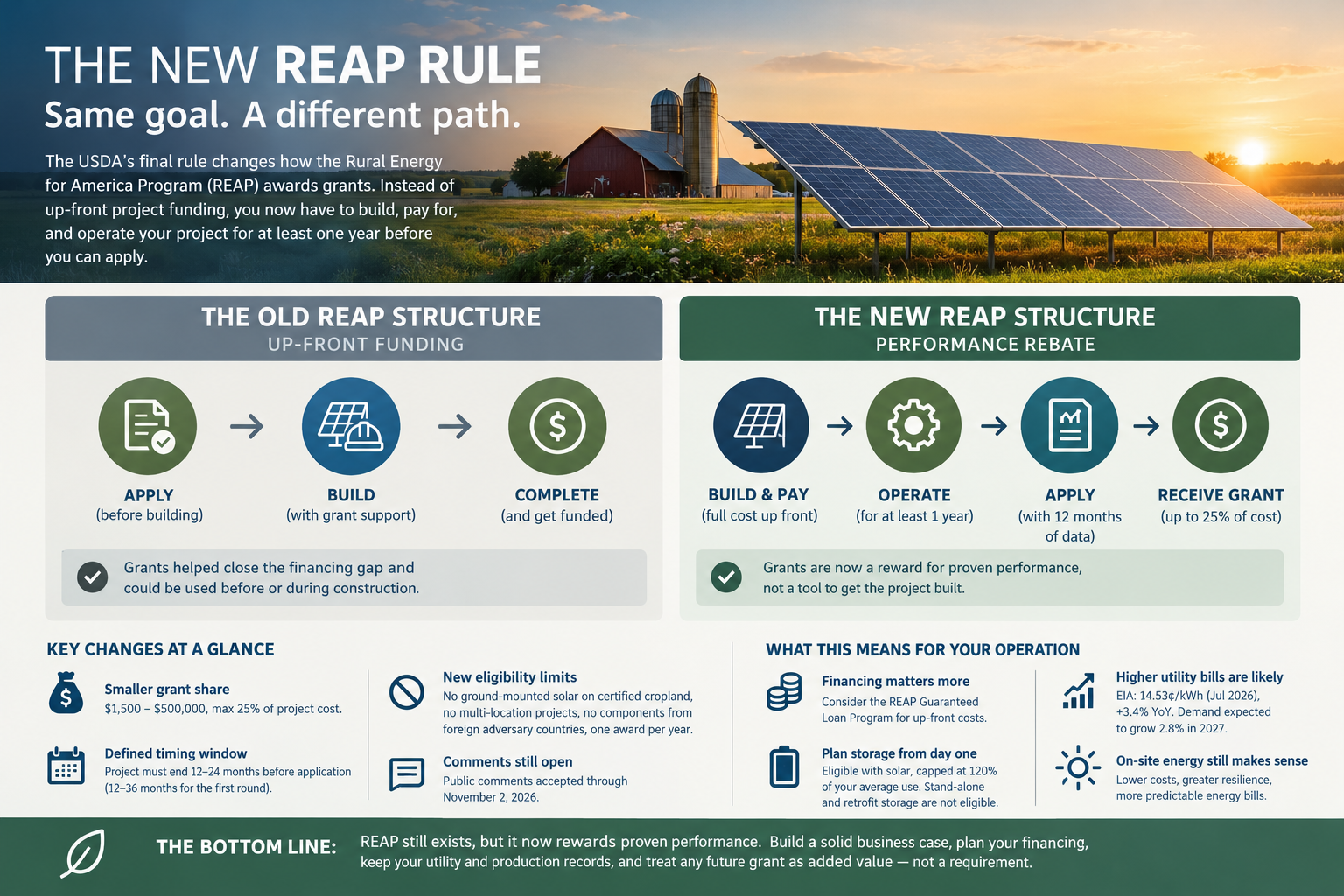
- Build first, apply later. According to the Federal Register notice, projects must be complete and operating before applying, and applications must include 12 months of actual production or savings data alongside 12 months of pre-installation data.
- A defined timing window. The project period must end 12 to 24 months before the application date. For the first application round only, that window extends to 12 to 36 months.
- A smaller grant share. Per Solar Power World's review of the rule, renewable energy grants now range from $1,500 to $500,000 and can cover no more than 25% of project cost. The rule's own cost-share requirement means a $1 million project needs at least $750,000 from other sources.
- New eligibility limits. Ground-mounted solar on certified cropland, multi-location projects, and systems with components made in countries designated as foreign adversaries are now ineligible. Applicants are limited to one award per federal fiscal year.
- Comments still open. Because this is a final rule with comment period, it already applies. USDA is accepting public comments through November 2, which the agency says may inform future guidance.
Why USDA Made the Change
REAP grant awards have been on hold since a March 31, 2026 USDA stakeholder announcement stopped processing of pending applications while the agency rewrote the program's rules. This final rule is the result. Applications that already had an obligation form signed by both the applicant and USDA before October 16 will continue to be processed. Other pending applicants will need to reapply under the new requirements.
In the rule, USDA gives three main reasons for the post-completion model: it removes the risk of funding systems that never become operational, it discourages systems sized larger than a business actually needs, and it gives the agency real performance data to score applications. USDA also cites stakeholder concerns about large ground-mounted projects displacing cropland, and says a planned online portal will shorten applications and review times.
Not everyone agrees with the direction. A coalition of farm and solar groups has filed suit challenging USDA's solar restrictions, according to Earthjustice, which represents them. The group's announcement notes that REAP supported 6,822 projects between 2023 and 2025, a reminder of how central the program has been to rural energy investment.
What This Means for Agricultural and Rural Businesses
A REAP Grant Is No Longer Construction Funding
Under the old structure, many operators treated a REAP award as committed money that helped close a project's financing gap. Now the owner pays for the full project up front, operates it for at least a year, and then competes nationally for a grant with no guarantee of an award. Any grant that does arrive is best treated as upside, not as part of the capital plan.
Financing Matters More Than Ever
USDA acknowledges in the rule that applicants may worry about financing projects when grant money comes after completion, and it points to the REAP Guaranteed Loan Program as the tool for up-front costs. Guaranteed loans are applied for separately, and combined REAP grant and guaranteed-loan support still can't exceed 75% of project cost.
Storage Needs to Be Planned From Day One
Battery storage installed with a new solar system remains eligible, but the rule caps storage capacity at 120% of the applicant's average energy use over the 12 months before installation. Stand-alone storage, and adding batteries to an existing system, are no longer eligible for REAP grants. Operators who want both solar and storage should design them together from the start.
Higher Utility Bills Are a Likely Outcome
None of these changes reduce the cost pressure on rural operations. EIA figures compiled by Energy Central show the national average commercial electricity rate reached 14.53 cents per kilowatt-hour in July 2026, up 3.4% from a year earlier, and EIA expects commercial demand to grow another 2.8% in 2027. Rising rates are a long-term structural trend, not a one-season spike.
The Role of On-Site Energy Solutions
The new rule asks projects to stand on their own economics, which is how a well-designed on-site system should be evaluated anyway. Solar paired with battery storage can help agricultural and rural operations:
- Reduce exposure to rising utility rates and demand charges
- Improve resilience where outages put livestock, product, or equipment at risk
- Lock in more predictable long-term energy costs
USDA's emphasis on right-sized systems also lines up with good design practice. A system sized to a facility's actual load, with storage matched to real usage, is more likely to pay off whether or not a grant follows.
The Key Takeaway
REAP still exists, but it now rewards proven performance rather than helping a project get built. Operators who hold off on energy upgrades while waiting for a grant may wait a long time, while their utility costs keep rising.
The practical approach is to build a business case that works on its own merits, structure financing to match (including a REAP guaranteed loan where it fits), and keep the utility and production records a future grant application will require. USDA has said an annual program notice will announce when application windows open and close.
Where to Start
For most organizations, the first step is understanding what's possible for their specific facility.
A feasibility analysis can evaluate:
- Available space and infrastructure
- Local utility rates and demand charges
- Incentives and financing options
- Potential system size and financial return
This provides a clear picture of whether an on-site system makes financial sense today, with any future REAP award as added value rather than a requirement.
Interested in exploring renewable energy for your facility? Start with our free feasibility analysis to understand the potential system size, financial value, and available incentives for your operation under the new REAP rules.
Sources
- USDA Issues Final Rule with Comment Period Ahead of Opening the Application Window for Rural Energy for America Program — U.S. Department of Agriculture
- Unleashing American Energy and Economic Prosperity; Rural Energy for America Program (REAP) — Federal Register
- REAP grant update makes solar projects on farmland ineligible — Solar Power World
- Farm and Solar Groups Sue USDA Over New Rules Blocking Solar Funding for Rural America — Earthjustice
- October 2026 Power Market Check: Demand Is Rising, but the Signals Are Not All Pointing the Same Way — Energy Central
Further reading
- REAP Final Rule Public Comment Docket (RBS-26-BUSINESS-0529) — Regulations.gov
Stay Informed with HSI
Get the latest news and updates from HSI Solar Company.
USDA's New REAP Rule: Build First, Apply Later. What It Means for Rural Operators

What the New Grid Equipment Executive Order Means for Commercial Solar and Storage

What the Stalled 2026 Farm Bill Means for REAP-Eligible Businesses